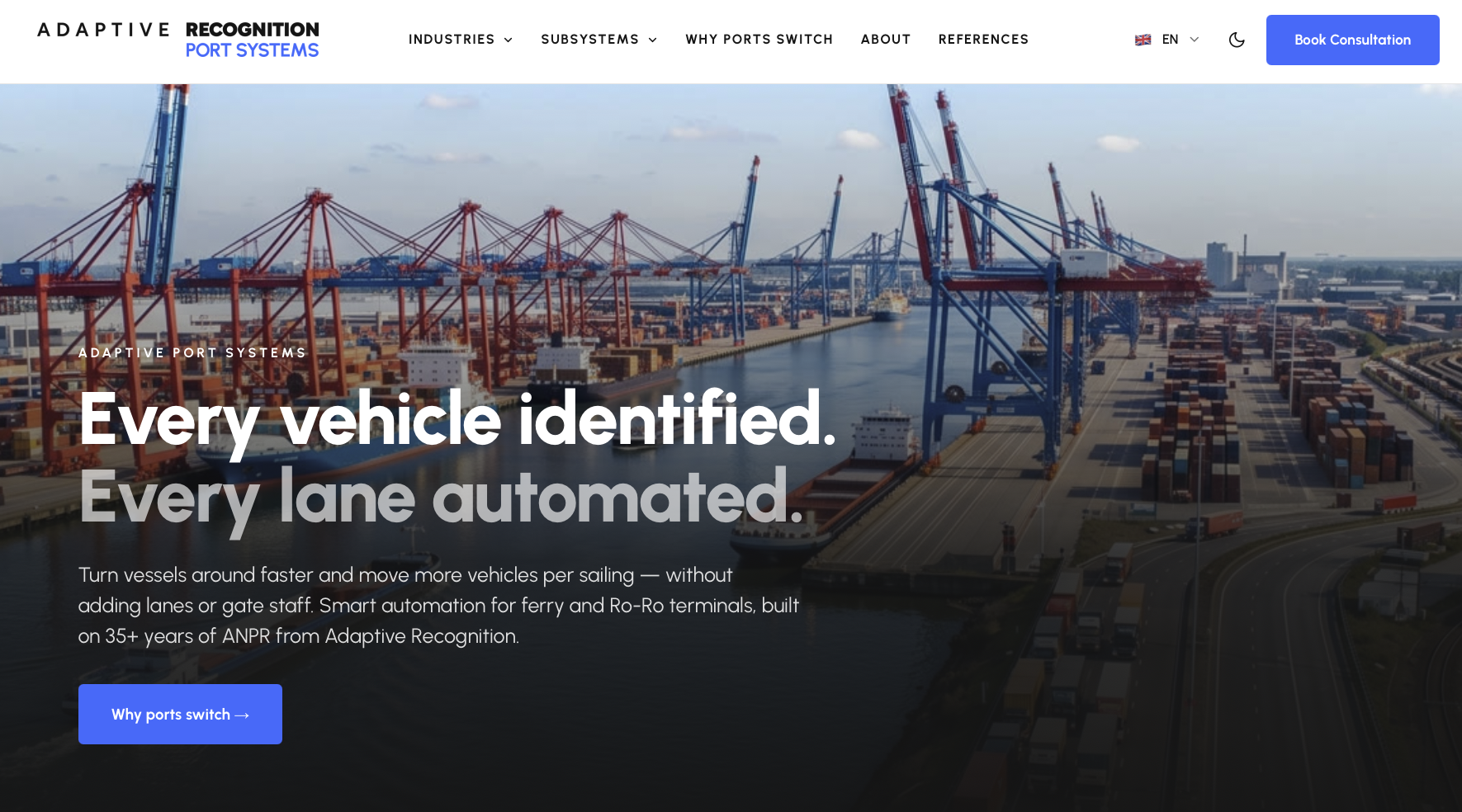
We built adaptiveportsystems.com in 30 days so sales stops answering the same eight questions
We built adaptiveportsystems.com in 30 days so sales stops answering the same eight questions
Adaptive Port Systems went live on 1 September 2026. LESO LABS was the sole developer: design, frontend, backend, hosting, deployment pipeline, security and the supporting slide decks.
Site: adaptiveportsystems.com
The problem was not the website. It was where the answers lived.
Adaptive Port Systems sells port automation to ferry terminals and Ro-Ro ports. Long sales cycles, technical buyers, several people on the customer side.
Those buyers asked the same questions every time:
How long does deployment take?
Do you supply hardware, software, or both?
Who installs the kiosks, barriers and signage?
What does the SLA cover?
Where is the data stored?
What integrations are supported?
Are you ready for EES and ETIAS?
Every answer was given by a person, in an email or on a call. Nothing accumulated. The next buyer started from zero. A commercial director researching options at 22:00 on a Sunday had nowhere to go, so the evaluation either stalled or moved to a competitor with better public information.
That is a content problem, not a sales problem. Sales time was being spent on work a page can do once and then do forever.
What we built
Twelve published pages, structured around how port operators evaluate, not around how the company is organised.
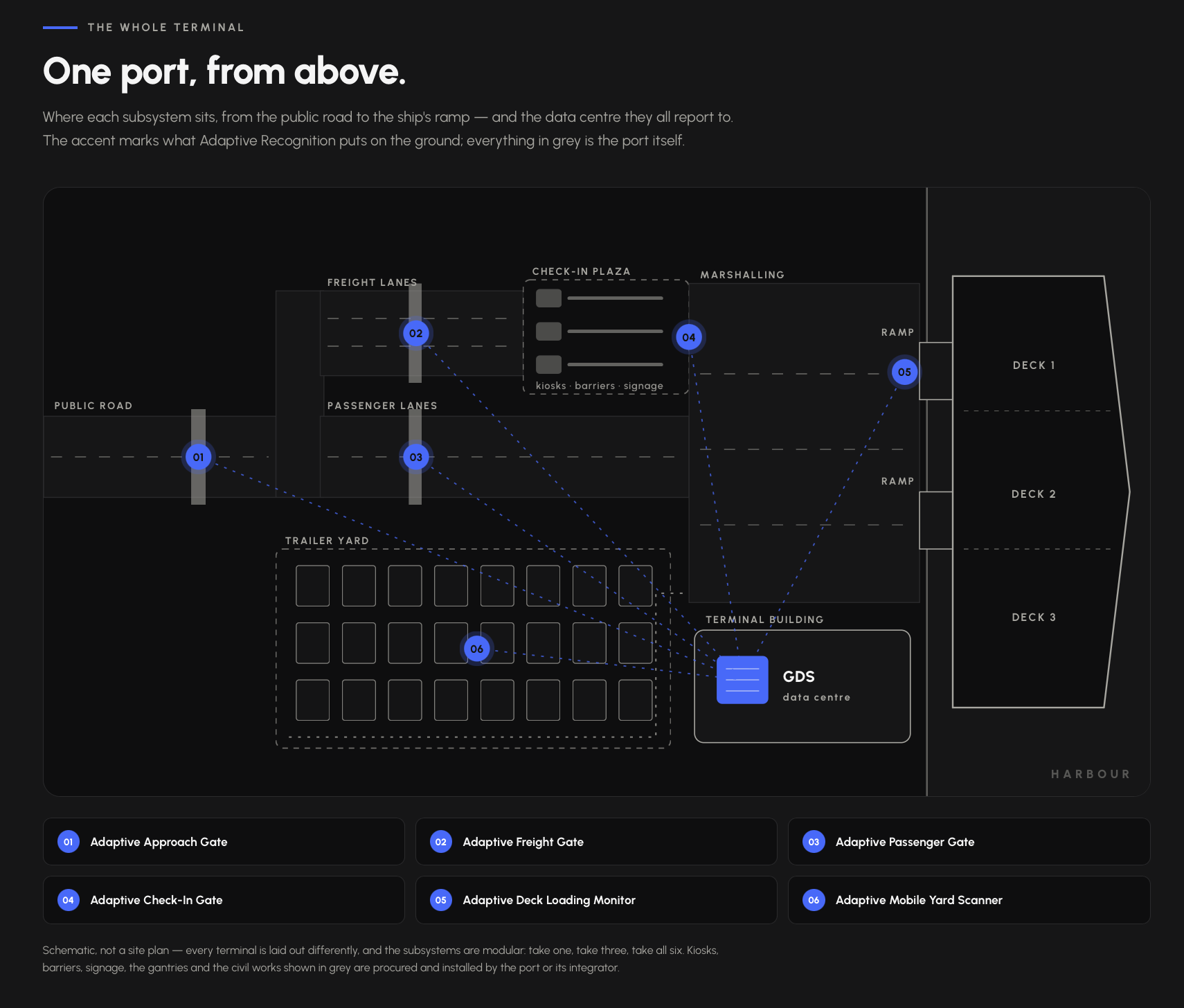
A landing page carrying the full narrative: the cost of the manual gate, the outcome, all six subsystems, the data layer, references, security, engagement model and FAQ.
A business case page for the commercial buyer, with an ROI calculator that models savings against the reader's own terminal numbers.
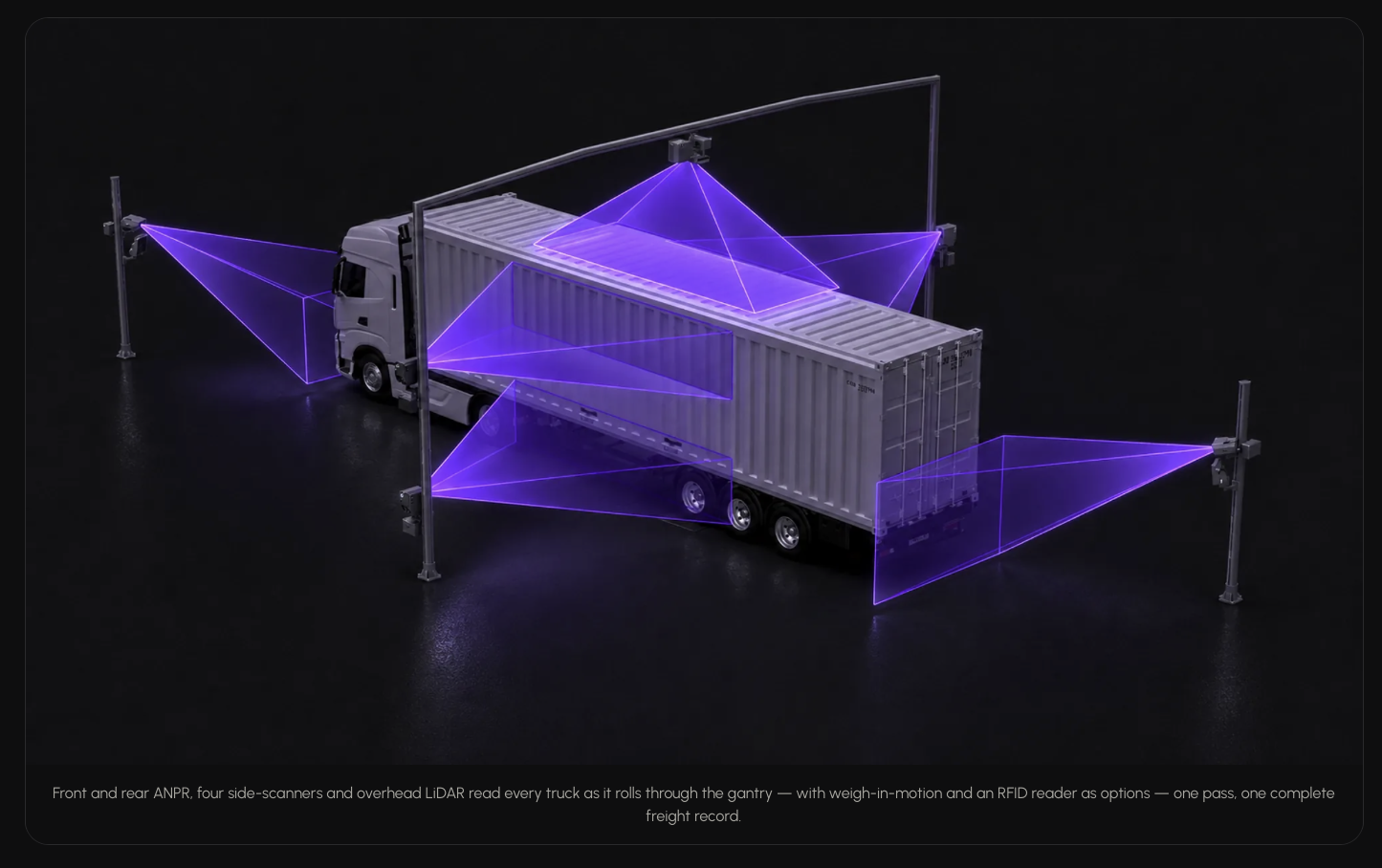
Six subsystem pages, one for each product in the range, each with its own scope of supply.
Two industry pages, ferry terminals and Ro-Ro ports, with the canonical outcome figures.
A company page covering the Budapest and Copenhagen split and the full lifecycle services.
One conversion page: book a consultation.
Around that: 138 image, video and logo assets, light and dark themes, product demo videos on the subsystem pages, and open developer resources so an integrator can build against a server simulator before a single camera ships.
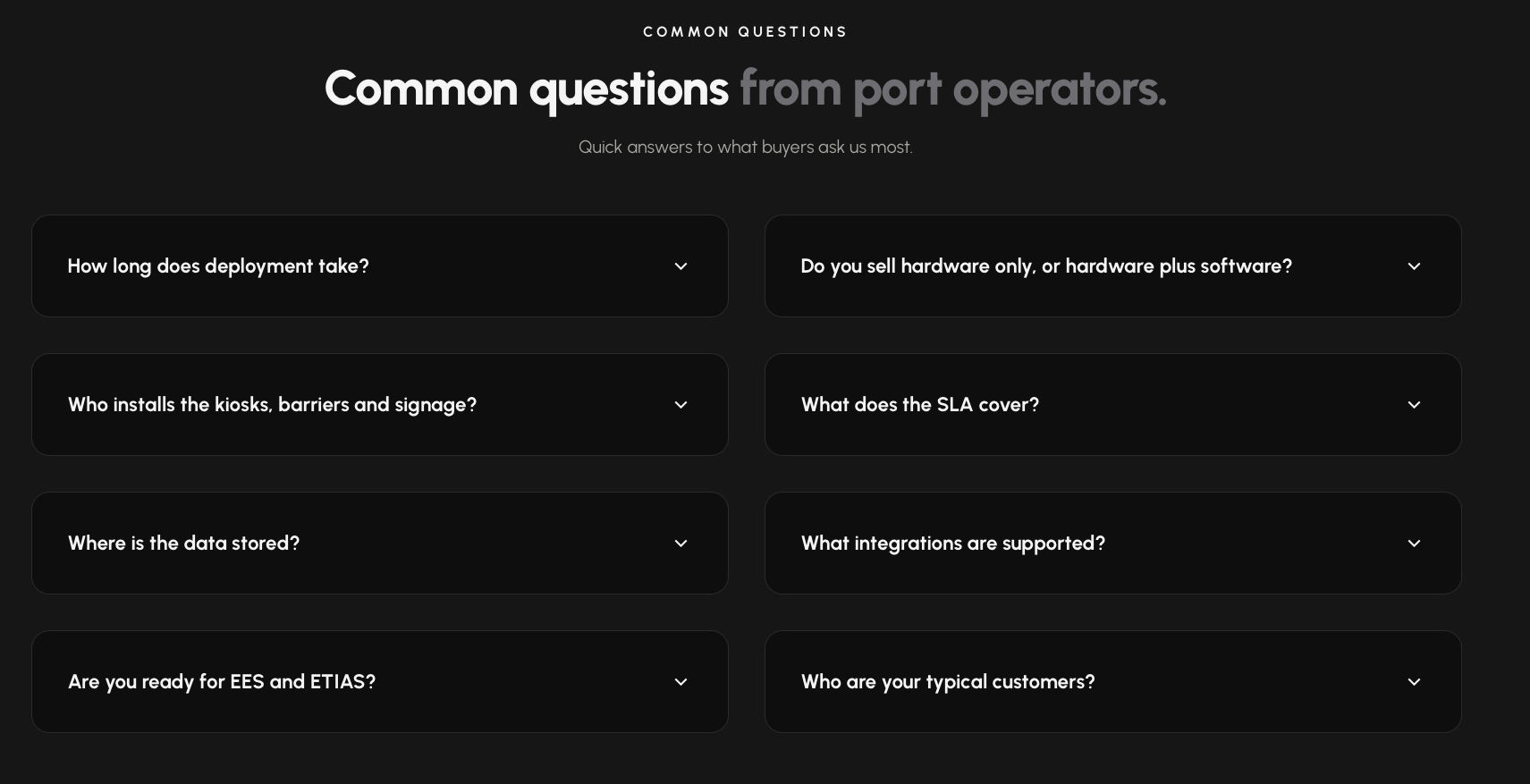
The FAQ is a sales artifact, not filler
The eight questions on the homepage are the questions the sales team was answering by hand. They were collected from real conversations, then answered in public, in the operator's language.
The loop continues after launch:
A buyer reads the site and self-serves.
Anything still unanswered goes to sales.
Sales reports the question back.
We publish the answer.
The next buyer never has to ask.
The site gets more useful every month instead of ageing. That only works when publishing is cheap and fast, which is a deployment decision, not a content decision.
We published the boundary, not just the pitch
Most vendor sites hide where their responsibility ends. This one states it on every subsystem page: the recognition layer, cameras, readers, engines and the data platform are supplied by Adaptive Recognition, while kiosks, barriers, signage, cabling and civil works are procured by the port or its integrator.
Publishing that boundary removes the most expensive misunderstanding in a technical sale, the one usually discovered at handover. It also filters out badly matched leads before they consume a sales cycle.
Every performance figure on the site was verified with the product and engineering side before publication, and qualified where results depend on port layout, traffic mix and lane design. Numbers you cannot defend in a tender are worse than no numbers.
Just over 30 days, one team, double shifts
Scope delivered by LESO LABS:
Content gathering and technical interviews with the product and engineering teams
Information architecture, copy structure and design system
Frontend and backend build
Server provisioning and hosting
Automated deployments and updates
Monitoring and AI-assisted security controls on the site and the servers
Supporting PowerPoint decks for sales and partner meetings
One vendor across the whole stack removed the usual handoffs between agency, developer, hosting provider and designer. No waiting on a third party to deploy a copy fix. That is where most of the 30 days came from.
English today, other languages in hours
The site ships in English. Content is separated from the interface, so adding a language is a translation task, not a rebuild. When a Nordic, German or French market justifies it, the version goes live in hours.
What to measure over the next 90 days
The site is one day old, so there are no performance claims to make yet. These are the metrics worth watching:
Repeat questions reaching sales, which should fall
Consultation requests and their quality
Pages read before a form is submitted
Time from first touch to first call
New questions logged by sales and published back to the site
If the first number falls and the last number keeps growing, the site is doing its job.
Working with LESO LABS
We build the software, the site and the infrastructure under one roof: custom development, AI integration and product design, from Copenhagen.
Send us the ten questions your sales team answers most often. We will show you the site structure that answers them, and what it takes to build it.
Contact: lesolabs.com